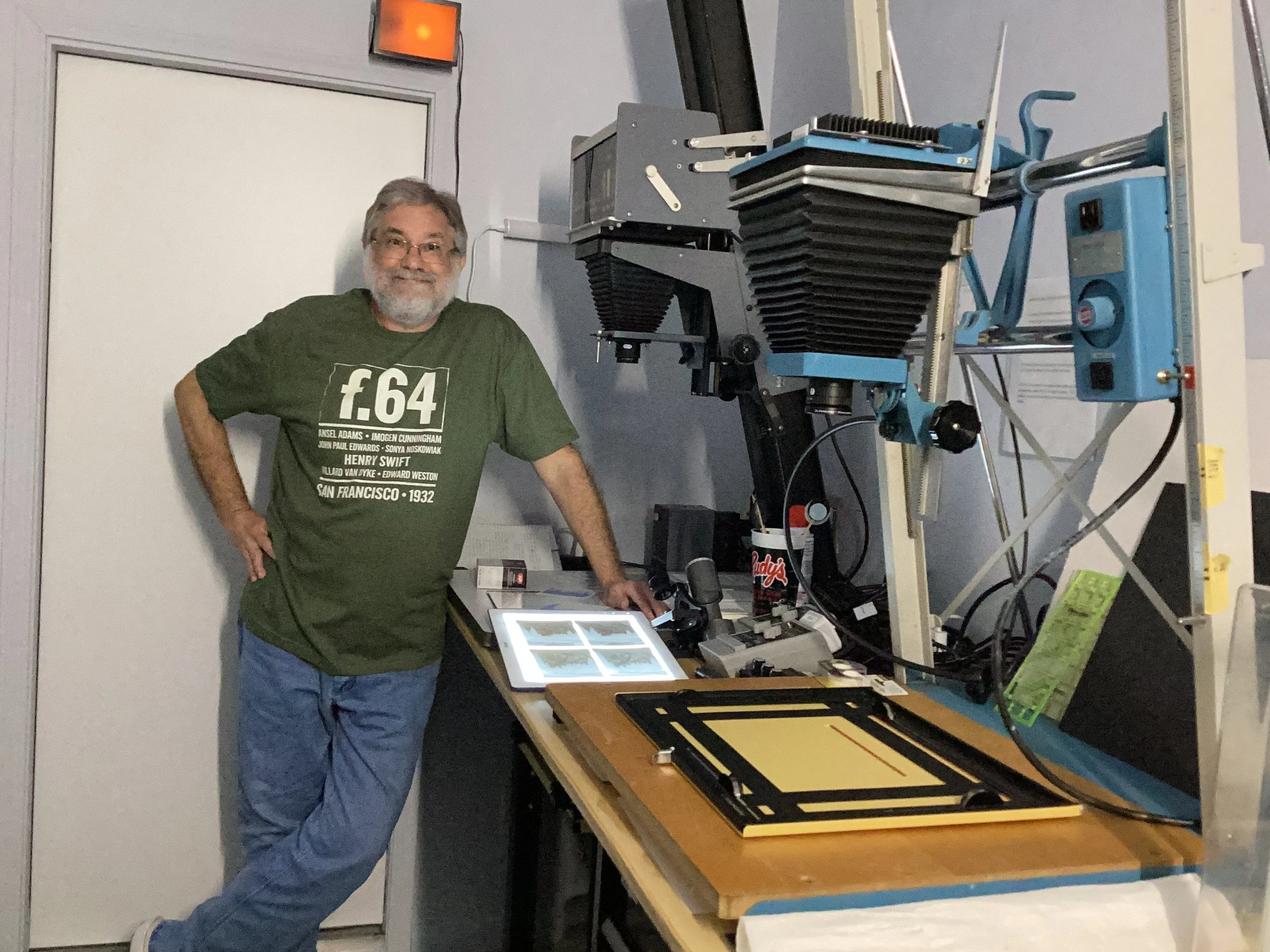
From My Darkroom . . .
My darkroom is my “happy place.” While it sometimes gets a bit claustrophobic, I relish the time being disconnected from a crazy, technology-dependent world. There is no “AI” generating anything for me. The prints that come from my darkroom are strictly handmade, by me, one at the time.
My father-in-law constructed my first darkroom in a small niche by the hot water heater in our garage. I had room for one enlarger and mostly printed 8x10 and with some finagling, I could print 11x14. After I retired in 2021, we hired a contractor and expanded the darkroom to allow me to set up both of my enlargers and print up to 16x20.
I use two enlargers, by Omega and Beseler, respectively. The Omega has a Chromega, halogen light head capable of handling negatives up to 4x5 inches. This was the first enlarger that I acquired. In late 2025 and early 2026, I transplanted a larger, “XL” column on it, and mounted it on a larger baseboard. This has facilitated the creation of larger prints. The Beseler MCRX enlarger once belonged to Dr. D. Gentry Steele, my late mentor. Using it brings back fond memories, and I still miss not being able to call him from the darkroom with a photography-related question. I replaced the Aristo head on the Beseler with a Heiland LED head. One of the best features of the Heiland is the lack of heat produced by LEDs compared to the halogen bulb (even though my darkroom has its own HVAC duct, it still gets uncomfortably warm during the long Texas summers). I use a number of lenses from Nikon, Rodenstock, and Schneider, covering negative sizes between 35mm and 4x5 inches.
On the “wet” side of the darkroom, I have a Delta 1 sink that will accommodate up to three 16x20 trays. Prints are developed in Kodak Dektol, fixed with Ilford’s Rapid Fixer, processed and washed according to the Ilford Archival Procedure, including toning with selenium for longevity and visual impact. Once I have selected a negative, I will make an 8x10 print to judge a negative’s potential. Although some purist photographers decry cropping negatives, I will always crop, burn, dodge, and mask negatives and prints to best achieve what I saw and felt in the field, or better tell the stories I want to tell with my prints.
I believe it is paramount for my art that I develop my own film and make my own prints. While I do not impose this strict criterion on any other artists, working in my darkroom and processing prints by hand gives me a tangible connection to my chosen medium that sitting in front of a computer just does not do. Watching the image form in the developing tray never gets old. And there is a depth to these images that (to my eyes) seems lacking in prints made by inkjet. There are plenty of artists doing amazing work using digital cameras and printers, nonetheless, I prefer the “magic” of silver gelatin prints created in my traditional darkroom.